



The company opens the job
When a company ships a new release, the job enters the queue automatically. No proposals are written, no negotiation takes place; the job is in the queue with its fee on it.

BountyShift is a marketplace where software testing jobs are distributed. A company drops its new release into the queue; a tester picks up the job from home, on their own computer or phone. What was done is recorded automatically, and the job’s value is added to the balance.
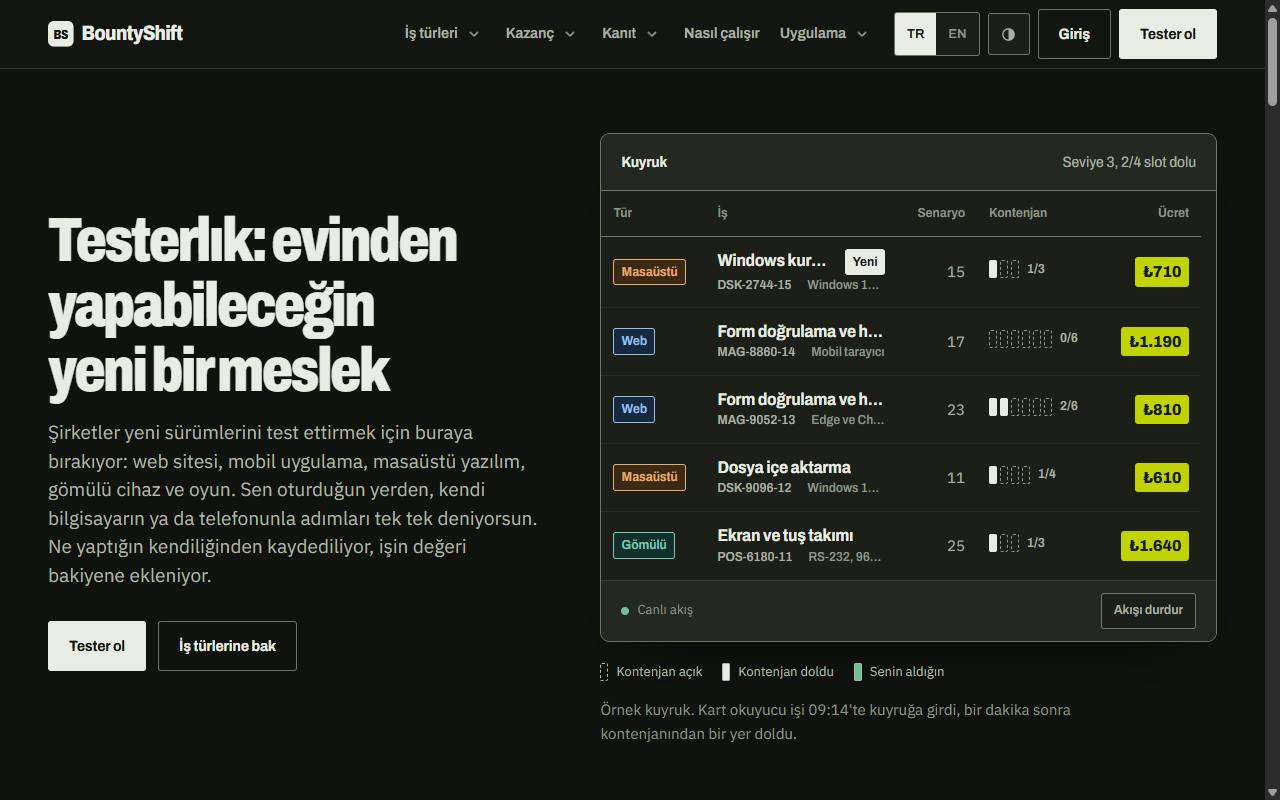
BountyShift is a marketplace where software testing jobs are distributed by quota. There are five job types: website, mobile app, desktop software, embedded device and game testing. Each job’s fee is fixed and known before it is taken; it does not vary with the number of bugs found, and a job with no bugs found is still paid. Payouts are weekly and no commission is taken from testers.
When a company ships a new release, the job enters the queue automatically. No proposals are written, no negotiation takes place; the job is in the queue with its fee on it.
Jobs not open to a tester’s level, not fitting a free slot or not matching their available environment are never shown to them.
How many testers a job takes is written on the job; how many jobs a tester can hold at once is set by their level. Both are known from the start.
Environment fingerprint, scenario timestamps and file digests are written by the agent. Neither the tester nor the platform can edit them afterwards; the record is kept for 24 months.
The amount is written on the job and does not change after delivery. The value of an accepted job is added to the balance and payouts are made weekly; no commission is taken from testers.
If a report is rejected, the client must state a reason. The discussion runs on the record, not on who remembers what.
Websites and panel applications. Browser matrix, form validation, checkout flow and accessibility scenarios. The tester’s own computer is enough.
iOS and Android apps. A real device is required; the requested model and version are written on the job.
Let’s evaluate the user structure, integration needs and, if any, options to adapt it to your brand.
It has two sides. Companies drop jobs into the queue to have their new releases tested; testers pick up web, mobile, desktop, embedded device and game jobs from home, on their own devices. The work is fully remote; no proposals are written and nothing is negotiated, the job is in the queue with its fee on it.
There are two separate quotas. The first is the job’s own quota: the company ordering the test writes how many testers it will take on the job, and the job leaves the list when it is full. The second is the tester’s slot limit: it determines how many jobs they can hold at once based on their level. Both are known from the start.
No. Payment is fixed per accepted job and is written on the job before it is taken. Finding zero bugs does not block acceptance of the report; what is paid for is that the scenarios were run. No commission is taken from testers.
The desktop agent records the environment fingerprint and the start and end stamp of every scenario itself. The tester adds screenshots, screen recordings, logs and reproduction steps on top. Both go out in a single package and cannot be edited afterwards; the record is kept for 24 months.
The client must state a reason. The tester can dispute it; the dispute is assessed on the run record, not on who remembers what. If the tester is found right, payment is released and their acceptance rate is unaffected.

Independent testing and finding verification for web, mobile and API products.
View product